
Australia 2026 Schedule & Game Calendar
View or download the complete 2026 Australia World Cup season schedule: all games, scores, venues, and broadcast info.
Australia 2026 Schedule & Results
Gear Up for the Game
As an Amazon Associate we earn from qualifying purchases. Prices checked Sep 17, 2026.

Gear Up for the Game
As an Amazon Associate we earn from qualifying purchases. Prices checked Sep 17, 2026.
Game Details
- Venue
- Lumen Field
- Location
- Seattle, Washington
- Time
- 3:00 PM EDT
The United States hosted the Australia at Lumen Field in Seattle, Washington on Friday, June 19, 2026. The final score was United States 2, Australia 0. This was a FIFA World Cup game.
Gear Up for the Game
As an Amazon Associate we earn from qualifying purchases. Prices checked Sep 17, 2026.
Game Details
- Venue
- Levi's Stadium
- Location
- Santa Clara, California
- Time
- 10:00 PM EDT
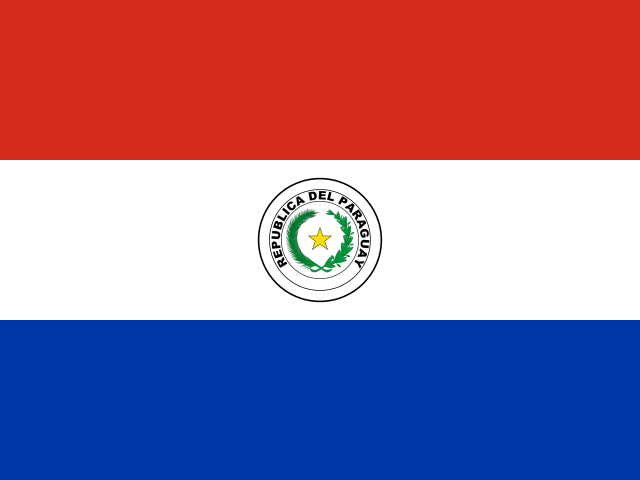
The Paraguay hosted the Australia at Levi's Stadium in Santa Clara, California on Thursday, June 25, 2026. The final score was Paraguay 0, Australia 0. This was a FIFA World Cup game.
Gear Up for the Game
As an Amazon Associate we earn from qualifying purchases. Prices checked Sep 17, 2026.
Game Details
- Venue
- AT&T Stadium
- Location
- Arlington, Texas
- Time
- 2:00 PM EDT
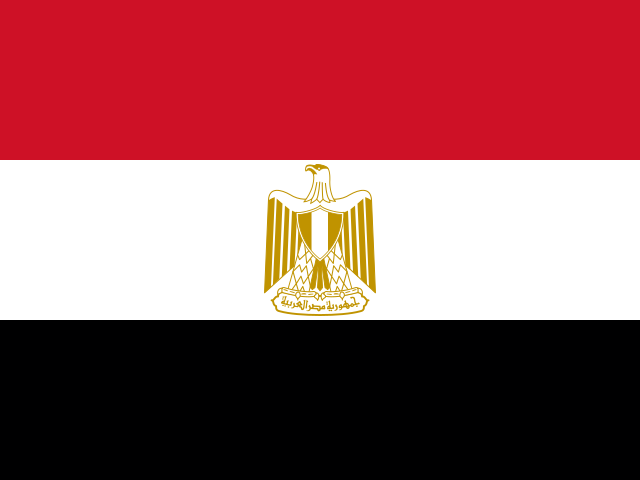
The Australia hosted the Egypt at AT&T Stadium in Arlington, Texas on Friday, July 3, 2026. The final score was Australia 1, Egypt 1. This was a FIFA World Cup game.
Shop World Cup fan gear
Official match balls, kits, and fan gear — delivered by Amazon.
As an Amazon Associate, we earn from qualifying purchases. Prices and availability are subject to change. Prices checked Sep 17, 2026.
adidas In Stock
Adidas Unisex-Adult World Cup Soccer Ball, White/Team Royal Blue/Solar Blue/Power Red, 4
$39.99 View on Amazon
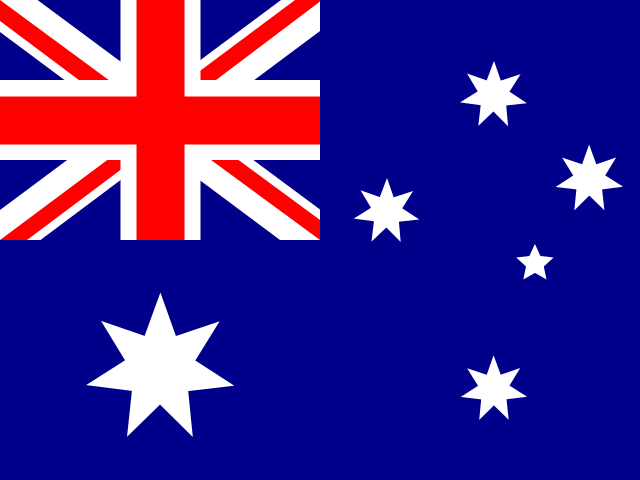
The Australia play in the FIFA-WORLD-CUP (FIFA World Cup). Their 2026 schedule includes 4 games. They have 2 home games and 2 away games this season.
Download the complete Australia 2026 schedule as an ICS calendar file, CSV spreadsheet, or printable PDF using the Download button on the schedule above. Pick the full season, a single month, or a head-to-head matchup.
About This Service
Australia's draw in Group D at the 2026 World Cup
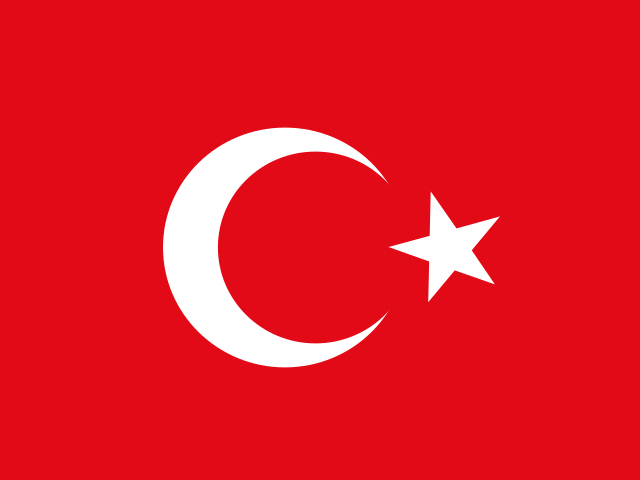
Australia begin the 2026 FIFA World Cup in Group D, drawn with Turkey, the United States, and Paraguay. The mix is unusual: one UEFA side, one CONCACAF co-host, and one CONMEBOL side, which gives Australia a different style of opponent in each of their three group games. The campaign opened well. On June 14 Australia beat Turkey 2-0 at BC Place in Vancouver, a 12:00 AM ET start that put three points on the board straight away. From there the schedule crosses into the United States. On June 19 Australia travel to Seattle to play the host nation at 3:00 PM ET, then close out the group on June 25 against Paraguay at the San Francisco Bay Area Stadium, a 10:00 PM ET kickoff with Australia listed as the away side. Two of the four teams in each of the 12 groups go through to the new 32-team knockout stage, and the eight best third-placed sides join them. Win on the opening night and you set up the rest of the group on your own terms. That is where Australia sit now, with a victory banked and two games left to settle whether they top Group D, take second, or chase one of the third-place spots.
Australia's three Group D games, date by date
Australia's group runs across 11 days and three different host cities, which makes the calendar worth pinning early. It started on Sunday, June 14 against Turkey at BC Place in Vancouver, a 12:00 AM ET kickoff that ended 2-0 to Australia. Those three points change the shape of everything that follows, because a side that opens with a win can afford to play the next two games on its own terms. Next comes the host nation. Australia face the United States on Friday, June 19 in Seattle at 3:00 PM ET, an afternoon start and the only daytime fixture of their three. The group closes on Thursday, June 25 against Paraguay at the San Francisco Bay Area Stadium, a 10:00 PM ET kickoff where Australia are the away team. Each fixture below carries the venue, the host city, and the kickoff in US Eastern, and the times update on their own if the schedule shifts.
Sizing up Turkey, the United States, and Paraguay
Group D hands Australia three opponents from three different confederations. Turkey, the UEFA entry, were first up in Vancouver and left with nothing after a 2-0 defeat, which hands Australia an early edge in the table. The United States come next, a CONCACAF side and one of the three host nations, so Australia meet them on home soil in Seattle with a partisan crowd to deal with. Paraguay, from CONMEBOL, are the closing opponent in San Francisco, and by then the group may be tight enough that goal difference decides the order. For Australia the value of the opening win is simple: it turns the last two matchdays into a controlled chase for points rather than a scramble. None of these are gimme games in a 48-team field, and the side that reads each matchup correctly is the one that comes through Group D in the position it wants.
Where Australia go after the group stage
Topping or placing in Group D only opens the door. The 2026 World Cup is the first to run with 48 teams and a 104-match schedule, and it adds a Round of 32 ahead of the Round of 16 that older fans will remember as the first knockout round. If Australia finish first or second, or sneak through as one of the eight best third-placed teams, they move into a bracket that runs Round of 32, Round of 16, quarterfinals, semifinals, and the final on July 19, with a third-place match alongside it. Australia will not know their first knockout opponent until every group has played its final round, because the bracket only fills once all 12 groups are settled. The moment that opponent is confirmed, it lands on this page and in any calendar you have synced, with the date, the venue, and the kickoff time attached.
How Australia’s 2026 World Cup is shaping up in Group D
Australia landed in Group D for the 2026 World Cup with a draw that asks three different questions across three matchdays. One opponent from Europe, one from the host region, one from South America. The three games run between June 14 and June 25, and they hop from Canada down the West Coast of the United States, so the travel is real even if the time zone math stays friendly for anyone watching from the Americas.
The start could hardly have gone better. Australia beat Turkey 2-0 at BC Place in Vancouver on June 14, and an opening win in a four-team group is worth more than the scoreline suggests. It means the next two fixtures, against the United States in Seattle on June 19 and Paraguay in San Francisco on June 25, can be approached with points already in hand rather than nerves already frayed.
Here is the part Australia cannot control and have to respect. A group’s top two reach the Round of 32 directly, the eight best third-placed teams from the 12 groups join them, and the order matters because group winners get a kinder slot in the bracket. The win over Turkey is a strong first step. It does not finish the job. Where Australia end up in Group D still rides on the Seattle and San Francisco results.
Walking through each Group D fixture for Australia
The opener is in the books. Australia played Turkey at 12:00 AM ET on June 14 at BC Place in Vancouver and won 2-0, the only one of their three group games staged in Canada. Three points, a clean sheet, and a platform. A start like that is exactly what a side wants from a group that gets harder on paper as it goes.
Game two takes Australia to Seattle on June 19 for a 3:00 PM ET meeting with the United States. This is the lone afternoon kickoff of the three, and it is the trickiest assignment on the schedule, because the United States are a host nation and will have the crowd. Australia go in as the away team. A result here, whether that is a win or a hard-earned point, would go a long way toward locking up a top-two finish before the final round even arrives.
The group wraps in San Francisco on June 25, when Australia face Paraguay at the San Francisco Bay Area Stadium at 10:00 PM ET. It is a late kickoff and the only one of Australia’s matches that starts after dark on the West Coast. By the time it begins, the Group D table may already be decided, or it may come down to this game and goal difference. Either way it is the date to circle, because finishing position is what sends a team into one half of the knockout bracket rather than the other.
Read across the three dates and the rhythm of Australia’s group becomes clear. A clean opening win in Vancouver, a daytime test against the host nation in Seattle, then a night finale in San Francisco that could be anything from a dead rubber to a winner-takes-second decider. The order of the games matters as much as the games themselves. Opening with the win means Australia get to treat the Seattle and San Francisco fixtures as chances to build on a lead rather than rescue a campaign, and in a four-team group that head start is the difference between dictating terms and counting on results elsewhere in Group D.
What first, second, or third place would mean for Australia
Finishing order in Group D is not just bragging rights, it sets the route. Win the group and Australia are seeded as a group winner, which the bracket rewards with a slightly softer pairing in the Round of 32. Take second and the draw can tilt the other way, often toward a group winner from a neighboring group. Slip to third and the picture gets more complicated still, because only the eight best third-placed teams from the 12 groups go on, and whether Australia would be among them comes down to points first and then goal difference and goals scored across the three matches.
That is why the 2-0 win over Turkey carries weight beyond the three points. It started Australia’s goal difference at plus two, and in a format where third place can hinge on a single goal, an early cushion is worth holding onto. The Seattle game against the United States and the San Francisco game against Paraguay will move that number in both directions, so Australia go into each one knowing the margin can matter as much as the result. A four-team group with one win banked is a good place to be, but it is not a finished job, and the two remaining matchdays decide everything about where Australia sit when the group stage ends.
There is also the question of rest and travel. Australia opened in Vancouver, then drop down to Seattle, then on to San Francisco, three host cities in 11 days. The schedule is compact, the time zone stays on the West Coast for the last two games, and the kickoff slots vary from a midnight Eastern start to a mid-afternoon one. For anyone planning to watch every minute, that spread is worth mapping out in advance, which is exactly what the calendar download below is built for.
Australia’s road through the 48-team knockout bracket
Come out of Group D and the expanded format takes over. The 2026 World Cup runs to 104 matches and introduces a Round of 32 that did not exist when the tournament held 32 teams, so there is one extra round to survive compared with every previous edition. Group winners, runners-up, and the eight best third-placed teams all funnel into that Round of 32, and from there it is straight elimination: Round of 16, quarterfinals, semifinals, and the final on July 19.
Australia’s first knockout opponent is not set, and it cannot be until all 12 groups finish their last matches. The bracket fills from the top as placings lock in, so the identity of whoever Australia would meet only becomes clear in the closing days of the group stage. You can track how every group is shaking out, and watch the bracket take shape, on the 2026 World Cup overview.
For a team that opened with a win, the knockout rounds are the reward and the test in one. Banking three points against Turkey was the easy part to enjoy. Turning a good group into a deep run means handling whatever the bracket throws up, and in a 48-team draw the early knockout opponents are far less predictable than they used to be.
Saving Australia’s World Cup schedule to your phone
Every Australia fixture on this page can drop straight onto your calendar. Hit the download button on the schedule above and you can pull the whole campaign as an ICS file, a CSV spreadsheet, or a printable PDF, and you can take the full set or just the single match you care about.
The ICS download is what most fans end up using. Bring it into Google Calendar, Apple Calendar, or Outlook and Australia’s group games appear with the kickoff times already shifted to your own zone, plus the venue and the host city for each one. Since the schedule is built from live tournament data, it corrects itself too: if a kickoff time moves, or once Australia’s knockout opponents are confirmed, those entries change without you lifting a finger.
Following more than one team through the tournament? The same downloads exist for every nation at the 2026 World Cup, so you can stack Australia’s fixtures next to another side and read the whole tournament off one screen. Block out June 14, June 19, and June 25 for the Group D games first, then let the knockout dates fill in behind them as the bracket forms.
Australia World Cup FAQ
Which group is Australia in at the 2026 World Cup?
Australia is in Group STAGE at the 2026 FIFA World Cup, alongside Turkey, United States, Paraguay, and Egypt.
When does Australia play at the 2026 World Cup?
Australia's group-stage matches are vs Turkey on June 14, vs United States on June 19, vs Paraguay on June 25, and vs Egypt on July 3, with kickoff times shown above in your timezone. Knockout fixtures are added once their opponents are decided.
How do I download Australia's World Cup schedule?
Use the download button on the schedule above to save Australia's fixtures as an ICS calendar, CSV, or printable PDF, then sync to Google Calendar, Apple Calendar, or Outlook.
Add Australia's World Cup fixtures to your calendar
Get every Australia fixture, from the Group D games to any knockout match they reach, as an ICS, CSV, or printable PDF. Sync once and the schedule stays current.